You might think you’re here to “learn” a language. But “learning” a language and “acquiring” one are two very different things, and that difference changes everything.
When you’ve acquired a language, you open your mouth and the language comes out. You don’t have to think before you speak. In fact, you can’t think about grammar and speak naturally at the same time, which may come as a surprise but will totally make sense if you reflect on your personal experience.
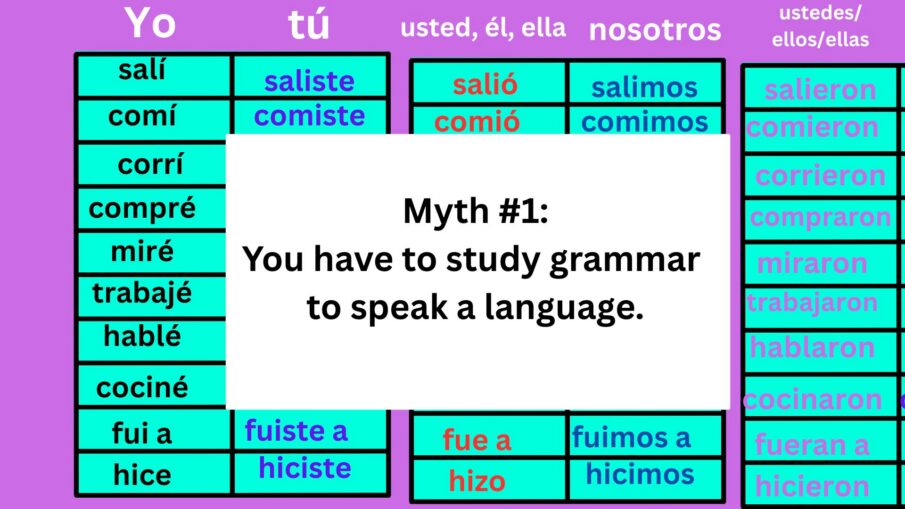
Learning “about” a language – conjugating verbs, studying where direct object pronouns go, memorizing vocabulary lists – is most likely what your language classes in school or in a language app were focused on. Maybe you worked hard, aced the tests, and felt frustrated that you still couldn’t hold a real conversation. Sound familiar?
Acquisition is automatic. It lives in a different part of your brain than memorized rules.
There is nothing wrong with you. The approach was the problem, not you.
If you’re reading this sentence, understanding it, and could talk about it with someone, you have already proven that you are capable of acquiring language. You did it once, and you can do it again, because this is how humans are neurologically designed to acquire language.
You’ve done this before
Think about how you acquired your first language. As a baby and toddler, you were surrounded by people speaking it. Nobody explained grammar rules to you, andnobody had you conjugate verbs or memorize vocabulary lists (can you imagine?!). You just heard the language, over and over, in context, and slowly it became yours.
The grammar rules came later, in school, after you could already speak and read fluently, But the acquisition came first. The “learning” you did in school was just labeling something you already owned.
Nobody hands you a physics textbook before you ride a bike
Think about learning to ride a bike: you didn’t have to memorize the parts of the bike or study angular momentum before you got on, because that would be absurd and counterproductive. You got on the bike, wobbled around, and eventually your body figured it out.
Language acquisition works the same way. Acquisition comes before the understanding of the rules. And yet, for some reason, we’ve been handing people language textbooks and telling them to start there.
The research backs this up
Linguist Stephen Krashen has spent decades studying exactly this. His Acquisition-Learning Hypothesis draws a clear line between the two processes, and his research gave birth to what’s now called Teaching with Comprehensible Input and Acquisition-Driven Instruction.
The core idea is simple:
we acquire language when we “understand messages in the target language” — when what we hear or read is just a little beyond our current level, but still comprehensible enough to make sense.
Today there is a growing global movement of classroom teachers teaching for acquisition rather than just for test scores, and students are graduating from high school with the ability to actually speak the language they studied. That’s the difference this approach makes.
What this means for your language journey
Studying harder is not going to get you there faster. Almost everything the traditional approach asks you to do is aimed at the wrong target.
The good news: acquisition doesn’t require more effort. It requires different effort. It asks you to relax, listen, understand, and trust that your brain is doing exactly what it was designed to do.
In the posts ahead, we’ll dig into the specific myths that get in the way: why speaking practice alone won’t make you fluent, why vocabulary lists don’t stick, why corrections can actually slow you down, and what to do instead.
Want to feel the difference?
The best way to understand the difference between learning and acquiring is to experience it. We invite you to join us for a free Zoom class on Monday, April 13th from 6–7pm EST — we’ll share the approach, answer questions, and give you a real taste of what a Comprehensible Input class feels like.