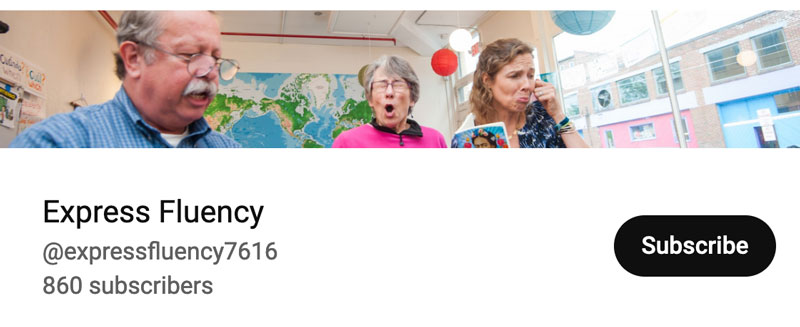
I was just at a YogaDance class. Have you tried this? I LOVED it. It was so joyful and playful. In the middle of class the instructor said “Fun should not be underestimated.” And this struck a chord. “YES!” It’s so true. Fun is a core element of an Express Fluency class, and not only because it feels good, but because feeling good is an indicator that the student is fully engaged and their mind is in language-acquisition mode.
When you are genuinely enjoying yourself, something important happens neurologically: your defenses come down, and your brain releases endorphins. Researchers call that lowered-defense state the affective filter. When we feel anxious, self-conscious, or on the spot, that filter goes up, and language acquisition slows to a crawl. When we feel relaxed, curious, even delighted, the filter drops, and the language flows in.
Stephen Krashen, the linguist whose research is the foundation of what we do at Express Fluency, identified this decades ago. A low affective filter isn’t just nice to have. It’s necessary.
And here’s the other piece: acquisition happens unconsciously. You don’t decide to acquire something. It just happens, quietly, below the surface, when your brain is engaged and at ease. The moment you’re straining and stressed and trying hard to memorize, you’ve switched into a different mode entirely, one that, frankly, doesn’t work very well for language.
This is why fun isn’t frivolous. It’s an essential part of the process.
I see this every week in class. When someone laughs at a story we’ve created together, I know something just landed. Not because they drilled it, but because they were there for it. They were present in the moment, and the language arrived right along with the joy.
I went to YogaDance to move and to enjoy myself. That was the whole plan. And yet I left having done things I didn’t know I could do, not because I worked at it, but because I was too busy having fun to be afraid of it.
I keep coming back to what that instructor said. “Fun should not be underestimated.” She wasn’t talking about language acquisition. But she could have been. Because in both cases, the most important thing isn’t what you’re trying to learn. It’s whether you forgot to try.
I hear this one all the time. I mention Express Fluency classes and someone responds: “I just need to move to (Spanish-speaking country). That’s the only way I’m really going to learn Spanish.”